
Iran’s Billboards: Visual Communication in Modern Warfare
Billboards, as an art form, are the defining symbol of the war in Iran. People tend to think of missiles, drones, tanks, and soldiers when they think of war. However, today’s wars are also played out through images and perceptions. That side of the struggle comes in full force in Tehran, where the Iranian regime has already blanketed the city with huge billboards and murals, while it is in an ongoing standoff with the United States and Israel.
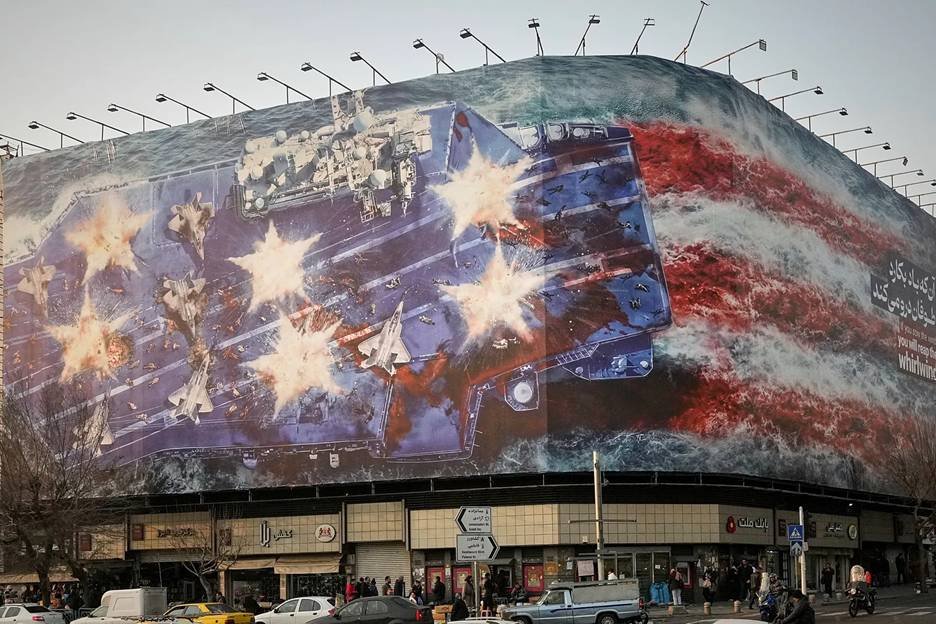
The most popular areas in town would be the missile display, Iranian military, Strait of Hormuz, and American political leaders, who would rotate, each displaying within these areas. In January 2026, authorities unveiled a mural in Enghelab (Revolution) Square: a picture of a warship, whose seabed was littered with war wreckage and streaked with blood that followed the route of the American flag stripes, was discovered as a warning to the USA for not taking action, although the ship’s surface was equally streaked with blood. The slogan read, “If you sow the wind, you will reap the whirlwind.” Around the same time, another banner near the former Israeli embassy in Tehran showed coffins draped in American and Israeli flags, warning both countries to watch out for their soldiers. They are not normal ads. These are part of a much bigger political and psychological communications battle.
Why does Iran use such large images?
Iran’s billboard buildings are designed not to show weakness but strength. They do not depict the suffering of a nation, but rather missiles, warplanes and soldiers in triumphant, victorious poses. That’s the message: Iran can strike back. It’s important because morale is affected by perception. When people think they can do nothing and as if they are helpless, an attack really has a psychological impression on people as well as a physical impression. If they think their state can still hold on, then the damage is mitigated.
This also makes scale an important factor to consider. A small poster is not the same as an image that covers the whole of the front of a building that is visible to all drivers, pedestrians and commuters that go past it. It’s no longer an ad; it’s an asset to the City. This kind of messaging takes place at Enghelab Square, which is particularly iconic to the recent trend and frequently the venue of state rallies and/or high visibility displays relating to the news cycle.
Deterrence
Military deterrence is usually associated with weapons and troop numbers, but communication plays a role too. An adversary needs to believe a state is capable of acting, and billboards are one way of making that belief visible.
Several recent exhibits have been dedicated to the Strait of Hormuz, the strangely narrow strait that is the channel through which about 20% of the world’s oil travels. Iran is tying its military strength to the strait, and in doing so is warning that if it enters a conflict, the implications would not end there, as this would have an impact all over the world on global energy prices. The message about the strait was so complex that one of the billboards in Revolution Square displayed two images of soldiers casting nets over naval vessels as well as a strait itself.
A long tradition, updated for the internet
Public political imagery has deep roots in Iran. Since the 1979 revolution, Tehran has used its walls and billboards to spread revolutionary slogans, honor the dead from the Iran Iraq War, and reinforce national identity. Researchers who study Iranian visual culture describe these murals as a longstanding tool for shaping public sentiment, one that blends explicit political messaging with religious and nationalist symbolism.
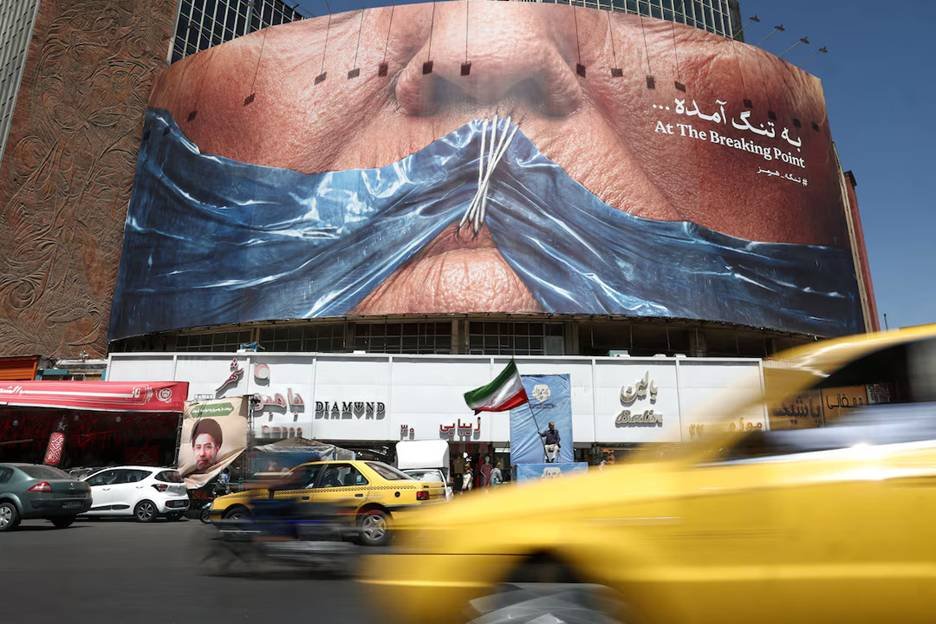
What has changed is the intended audience. A billboard is no longer aimed only at the people walking past it. It is built with the internet in mind. Anyone in Tehran can photograph a billboard and post it online within seconds, sending it to viewers in Pakistan, Europe, the Gulf, and the United States almost instantly. Iran does not need the world to visit Tehran. The billboard is the original content, and social media is simply the delivery system. That international reach is not accidental. Some displays are written in Persian alongside English, suggesting they were never meant to stay within Iran’s borders. In effect, the streets of Tehran double as the stage for an international information campaign: the physical billboard reaches people inside the country, and photographs of it reach everyone else.
Domestic politics
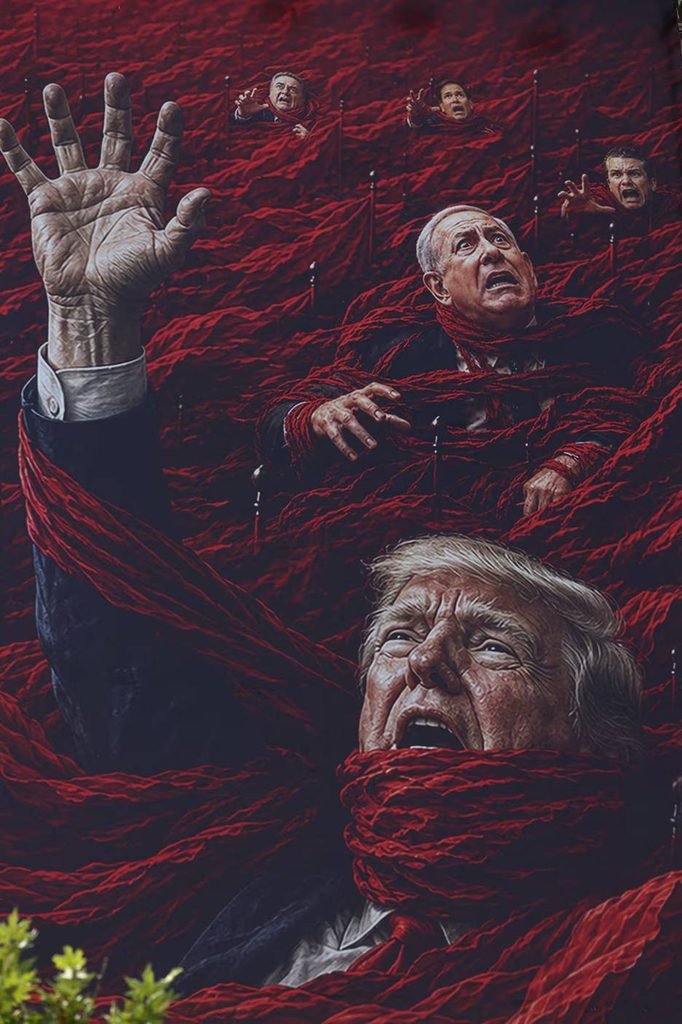
The campaign also serves a purpose at home. Iran has been grappling with a severe economic crisis, with inflation running above 40 per cent through late 2025 and into 2026 alongside a weakening currency and widespread protests over living conditions. Reporting on the unrest has noted that the government faces its most serious domestic challenge in years even as tensions with Washington escalate. In moments like this, public morale becomes a genuine strategic concern, and wartime imagery offers a way to frame domestic hardship as the product of an external threat rather than internal mismanagement. The underlying message becomes a call to unity: the country is under attack from a powerful adversary, so internal disagreements should be set aside.
But propaganda has limits. Images alone cannot sustain public trust in a government that fails to deliver results, and official messaging tends to lose credibility fast when people are struggling to afford basic goods. Aggressive imagery can also make diplomacy harder. In a political environment where the enemy is constantly framed as the source of national suffering, compromise starts to look like weakness, and public anger can make negotiation politically costly for leaders on both sides. That dynamic can feed a cycle of escalation, where one side’s hostile imagery draws a matching response from the other, amplified by social media until both audiences are fed a steady diet of revenge and victory narratives.
A new battlefield
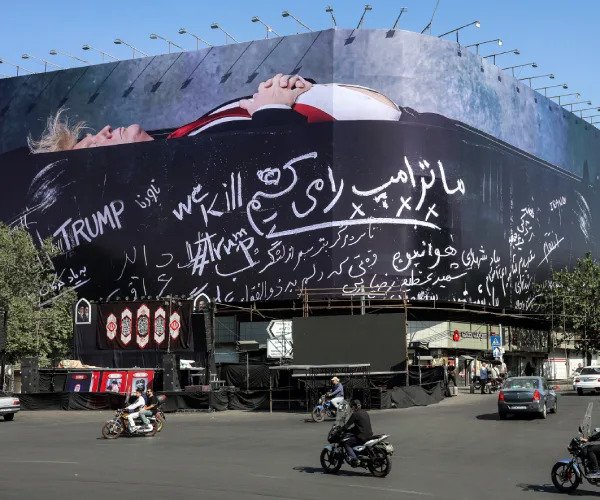
Iran’s billboards reflect a broader shift in how conflicts are fought today, not only on land, sea, air, cyberspace, and space, but in the psychological space where public opinion forms and governments make decisions.
Every image covering Tehran’s buildings points toward the same message: Iran is resisting, Iran can fight, Iran will retaliate, Iran is not afraid. Whether these claims are militarily accurate is a separate question from their strategic value, which comes entirely from their ability to shape perception. A missile can destroy a single physical target. An image can reach and influence millions of people at once.
Iran appears fully aware of this, turning its own skyline into a tool of strategic communication that speaks to its citizens, warns foreign governments, and feeds the global information environment all at the same time. Whether the strategy actually works depends less on how widely the images spread and more on whether people believe them. In information warfare, getting a message seen has become the easy part. Making it credible is the real challenge.
The views expressed in this article are solely those of the author and do not necessarily reflect the views of The Opinion Desk.