
Azerbaijan: A Crossroads of History, Geography, and Culture in the Caucasus

Azerbaijan is a fascinating country located at the intersection of Western Asia and Eastern Europe, in the historic region of the Caucasus. Known for its rich cultural heritage, strategic geography, and complex political history, Azerbaijan has long served as a bridge between civilizations.
From Pakistan, Azerbaijan lies roughly two thousand miles to the west. Travelers can reach it easily by air from cities such as Islamabad or Karachi. Overland travel is also possible through Iran, passing through cities such as Rasht before entering Azerbaijan.
One unique geographical feature of Azerbaijan is the region of Nakhichevan, an autonomous territory that is separated from the rest of the country by Armenia. Travelers can reach it through Iran, particularly via the city of Tabriz.
Azerbaijan operates on a time zone that is one hour behind Pakistan.
Geography and Natural Landscape


According to the Encyclopaedia Britannica, Azerbaijan covers an area of approximately 85,900 square kilometers (33,166 square miles). The country’s geography is remarkably diverse, shaped by mountain ranges, fertile plains, and coastal regions.
The Greater Caucasus Mountains stretch across the northern part of the country, while the Lesser Caucasus Mountains lie toward the south. Between these ranges flows the Kura River, creating a wide and fertile valley that forms one of Azerbaijan’s key agricultural zones.
To the south, the Aras River forms much of Azerbaijan’s border with Iran. Numerous smaller rivers originate in the Caucasus Mountains and flow eastward into the Caspian Sea, creating lush valleys along their course.
Azerbaijan shares borders with several countries, including Armenia, Iran, Russia (Dagestan), and Georgia. This strategic location has historically made it an important crossroads for trade, migration, and political influence.
Population, Capital, and Language
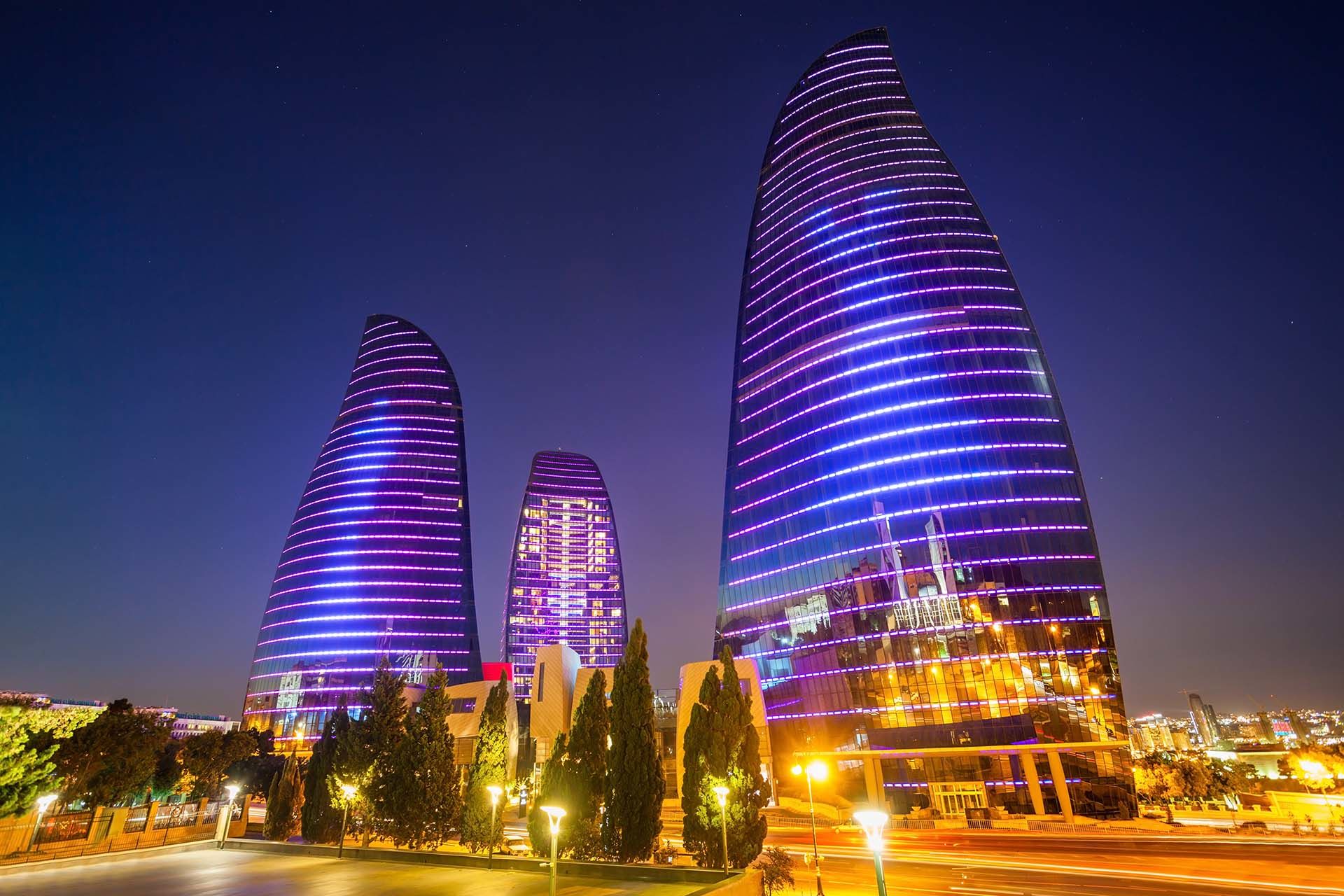


Azerbaijan has a population of over ten million people. Its capital city, Baku, lies on the western shore of the Caspian Sea and serves as the country’s political, economic, and cultural center. With a population of more than two million residents, Baku is also the largest city in the Caucasus region.
The official and most widely spoken language in Azerbaijan is Azerbaijani (Azeri). Linguistically, it belongs to the Turkic language family and is closely related to Turkish. Because of this connection, speakers of Turkish and Azerbaijani can often understand each other with relative ease.
Religion and Society
Around 97 percent of Azerbaijan’s population is Muslim, while small communities of Christians, Jews, and other minorities make up the rest.
Despite its Muslim-majority population, Azerbaijan is often described as one of the most secular Muslim-majority states. Religion plays an important cultural role, but the political system is based on secular governance.
The people of the Caucasus region are widely known for their hospitality, strong traditions, and resilient character. Communities living in the mountainous areas of Azerbaijan have historically developed a reputation for bravery, dignity, and cultural pride.
Climate and Weather
Azerbaijan’s climate varies significantly depending on altitude and distance from the sea.
Coastal areas near the Caspian Sea, including Baku, tend to be relatively dry. Summers are generally warm but pleasant, while winters remain moderate compared to inland mountainous regions.
As one moves northward or into higher elevations, the climate becomes colder and wetter. Mountain regions receive significantly more rainfall, sometimes reaching around forty inches annually.
Economy and Currency
The national currency of Azerbaijan is the Manat. Its value fluctuates in international markets but remains relatively stable within the region.
Azerbaijan’s economy relies heavily on oil and natural gas exports. The energy resources located near the Caspian Sea have made the country an important player in global energy markets.
Agriculture also contributes significantly to the economy. The country produces a variety of crops, including cotton, tobacco, and fruits, which are exported to several international markets.
Arrival of Islam in Azerbaijan
Islam reached Azerbaijan during the period of the early Islamic Caliphate.
Historical accounts suggest that during the caliphate of Caliph Umar (RA) in 21 AH, military expeditions were sent toward Azerbaijan under the leadership of Uqba ibn Farqad. Another commander, Bukayr, reportedly defeated the local ruler Isfandiyar and captured him alive, while his brother Bahram was forced to flee after military defeat.
The historian Al-Baladhuri, in his well-known work Futuh al-Buldan, records that after the Battle of Nahavand, the command of the region passed to Hudhayfah ibn al-Yaman (RA), who captured the important city of Ardabil. From this point onward, Islam gradually spread throughout the Caucasus region and the northern territories.
Russian Influence and the Struggle for Independence
During the nineteenth century, expanding Russian imperial power significantly altered the political landscape of the Caucasus.
Following increasing Russian pressure after 1812, a treaty signed in 1828 resulted in the division of Azerbaijani territories between Russia and Iran.
In 1918, the Russian-controlled portion briefly established an independent state. However, in 1922, the region was incorporated into the Soviet Union.
When the Soviet Union began collapsing in 1991, Azerbaijan was among the first republics to declare independence. During this turbulent period, Soviet forces launched a violent military crackdown in Baku, resulting in the deaths of thousands of civilians. The event remains one of the most tragic moments in the country’s modern history.
The Nagorno-Karabakh Conflict


One of the most significant conflicts in Azerbaijan’s modern history centers around the region known as Nagorno-Karabakh.
This mountainous territory lies within Azerbaijan but historically had a mixed population of Azerbaijanis and Armenians. Both sides claimed demographic majority and historical ownership of the area.
In the late 1980s, Armenian groups in the region began an armed struggle against Azerbaijani control, supported by the Armenian government. A guerrilla conflict lasted from 1988 to 1991, followed by a full-scale war between 1992 and 1994.
As a result of the war, Armenia gained control of Nagorno-Karabakh and approximately nine percent of Azerbaijani territory. A Russian-brokered ceasefire in May 1994 halted major fighting, but tensions remained unresolved.
A second major conflict erupted in 2020, during which Azerbaijan regained large parts of the disputed territories. By early 2024, Azerbaijan had established full control over Nagorno-Karabakh, marking a significant turning point in the long-standing dispute.
Azerbaijan stands at a remarkable crossroads of geography, history, and culture. From the peaks of the Caucasus Mountains to the shores of the Caspian Sea, the country reflects centuries of interaction between empires, religions, and civilizations.
Today, Azerbaijan continues to strengthen its identity as a modern state while preserving the deep historical legacy that has shaped its society for generations.
The views expressed in this article are solely those of the author and do not necessarily reflect the views of The Opinion Desk.