
The Hidden Danger of Headphones: Are We Slowly Damaging Our Hearing?
Imagine listening to your favorite song on the way to university, watching videos during your free time, or wearing headphones while studying or working. For many of us, headphones have become an essential part of everyday life. They help us concentrate, entertain us, and allow us to enjoy music without disturbing others.
But have you ever wondered what happens inside your ears when you listen to loud music for hours?
Although headphones themselves are not harmful when used responsibly, listening to sounds at high volumes for prolonged periods can cause permanent hearing damage. The concerning part is that this damage often develops gradually, without obvious symptoms in the early stages.
From students and office workers to gamers and music lovers, people of all ages may be putting their hearing at risk without realizing it.
So, are your headphones slowly damaging your hearing? Let’s explore the science behind this everyday habit and discover how you can protect one of your most valuable senses.
1. How Do Headphones Affect Our Hearing?
To understand how headphones can damage hearing, we first need to understand how our ears work.
When sound enters the ear, it travels through the ear canal and causes the eardrum to vibrate. These vibrations pass through three tiny bones in the middle ear before reaching the cochlea, a spiral-shaped structure located in the inner ear.
Inside the cochlea are thousands of specialized sensory cells called hair cells. These cells help convert sound vibrations into electrical signals that travel through the auditory nerve to the brain, allowing us to recognize and understand sounds.
However, these delicate sensory cells can be damaged by excessive noise exposure.
When you listen to music at a very high volume, the intense sound energy can overstimulate and damage the sensory structures inside your cochlea. Repeated or prolonged exposure increases the risk of permanent hearing loss.
Unlike some other cells in the human body, damaged cochlear hair cells do not naturally regenerate in humans.
This means that once significant damage occurs, the resulting hearing loss may be permanent.
The problem is not simply wearing headphones. It is how loud you listen, how long you listen, and how frequently you expose your ears to loud sound.
2. What Is Noise-Induced Hearing Loss?
Noise-induced hearing loss (NIHL) is hearing loss caused by exposure to excessively loud sounds.
It can occur after a single exposure to an extremely loud sound or develop gradually through repeated exposure to damaging noise.
When headphones are used at unsafe volumes for extended periods, they can contribute to this type of hearing loss.
Initially, the damage may affect the ability to hear certain high-frequency sounds. As the damage progresses, understanding speech and following conversations may become more difficult.
For example, you might find it harder to understand someone speaking in a crowded restaurant, even though you can still hear that person talking.
This happens because hearing involves more than detecting sound. Your ears and brain must also distinguish speech from background noise.
Why Is Hearing Loss Often Difficult to Notice?
Noise-induced hearing loss frequently develops gradually.
You may continue hearing everyday sounds and assume that your hearing is perfectly normal. However, subtle changes may already be affecting your ability to understand speech or detect quieter sounds.
Because these changes can be difficult to recognize, people sometimes ignore the early warning signs until the problem becomes more noticeable.
This is why preventing hearing damage is so important.
3. How Loud Is Too Loud?
Sound intensity is measured in decibels (dB). The higher the decibel level, the greater the sound intensity.
However, hearing damage depends on both the sound level and the duration of exposure.
Consider these examples:
| Sound level | Example | Potential hearing risk |
| 30 dB | Soft whisper | Very low risk under ordinary conditions |
| 60 dB | Normal conversation | Generally safe for prolonged listening |
| 80 dB | Loud everyday environmental sound | Exposure duration becomes important |
| 85 dB | Heavy traffic inside a car | Prolonged exposure can increase risk |
| 90 dB | Very loud sound | Safe exposure time decreases considerably |
| 100 dB | Very loud personal audio or environmental noise | Hearing damage can occur with relatively short exposure |
These are approximate sound levels. Actual headphone volume varies depending on the device, headphones, recording, and listening environment.
According to the World Health Organization (WHO), listening at an average level of 80 dB can be safe for up to 40 hours per week under its recommended exposure guidance. At 90 dB, the recommended weekly listening time falls to approximately four hours.
This illustrates an important principle: the louder the sound, the less time your ears can safely tolerate it.
Turning the volume up may make your music sound more exciting, but it also increases the risk of damaging your hearing.
4. Warning Signs That Your Headphones May Be Affecting Your Hearing
Your ears may provide warning signs when you have been exposed to excessive sound.
Recognizing these signs can help you take action before further damage occurs.
1. Ringing in the Ears (Tinnitus)
Have you ever removed your headphones and noticed ringing, buzzing, or whistling sounds even though nothing around you was producing them?
This condition is called tinnitus.
Tinnitus can occur after exposure to loud sounds and may be temporary or persistent. Although it has several possible causes, ringing after loud listening can be a warning sign that your ears have been exposed to excessive sound.
Persistent tinnitus should be assessed by a hearing healthcare professional.
2. Muffled Hearing
After listening to loud music, sounds may seem quieter or less clear than usual.
This temporary change can occur because excessive sound has affected the functioning of the auditory system.
Although hearing may recover after some temporary changes, repeated exposure can result in permanent damage. Temporary recovery does not mean that loud listening is harmless.
3. Difficulty Understanding Conversations
You may hear someone speaking but struggle to understand their words, particularly in noisy environments.
For example, conversations in classrooms, restaurants, shopping centres, or busy streets may become more challenging.
This difficulty can be associated with hearing loss, including noise-induced hearing loss.
4. Increasing the Volume Frequently
If you repeatedly feel that your usual listening volume is no longer loud enough, pay attention.
This does not automatically mean that you have hearing loss. Your listening environment, device settings, or audio content may also explain the change.
However, if you are also experiencing muffled hearing or difficulty understanding speech, consider having your hearing assessed.
Important: If you experience sudden hearing loss, seek urgent medical assessment. Do not assume that it will resolve on its own.
5. Earphones vs. Headphones: Which Is Safer?
Many people believe that over-ear headphones are always safer than in-ear earphones, or that earphones are automatically more dangerous because they sit inside the ear.
The reality is more complicated.
Both devices can expose your ears to damaging sound levels if the volume is too high.
The main factors affecting hearing safety are sound intensity, listening duration, and overall exposure.
In-Ear Earphones
Earphones sit inside the ear canal and deliver sound close to the eardrum.
They can be convenient for travelling, exercising, and everyday use. However, listening at high volumes for extended periods can increase the risk of hearing damage.
Over-Ear Headphones
Over-ear headphones cover the ears and may feel more comfortable during extended listening.
Models with effective noise cancellation can reduce background noise, making it easier to hear music or speech without turning the volume up excessively.
However, over-ear headphones are not automatically safe. They can also deliver dangerously loud sound.
Which Should You Choose?
Choose a comfortable, well-fitting device that allows you to hear clearly at a low volume.
If you frequently listen in noisy environments, consider well-fitted noise-cancelling headphones.
Remember that safe listening habits matter more than whether your device sits inside or outside your ears.
6. The 60/60 Rule: Is It Enough to Protect Your Hearing?
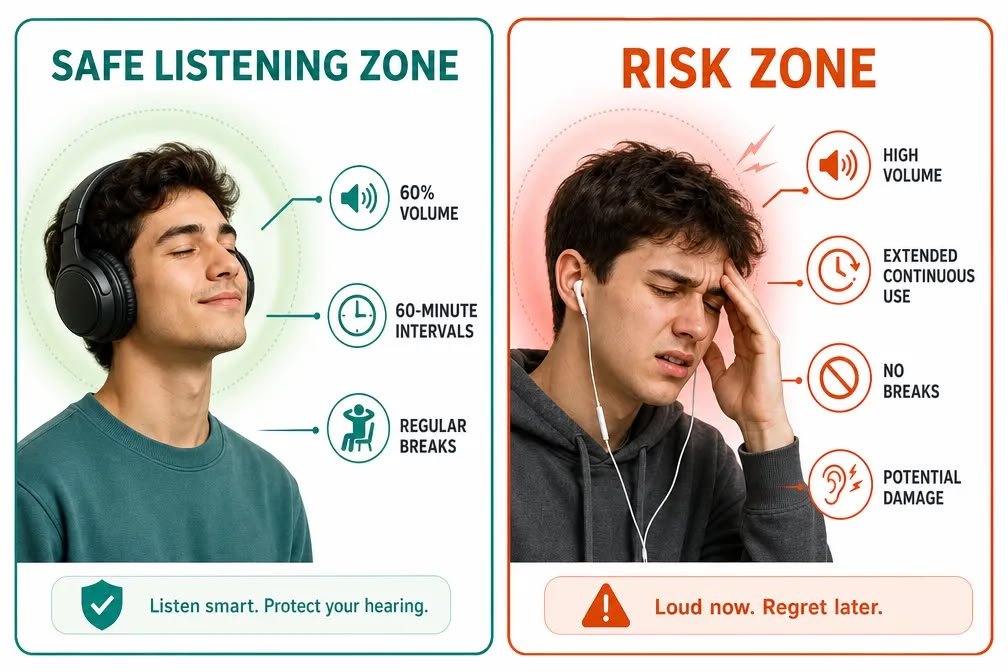
You may have heard of the 60/60 rule, which recommends listening at no more than 60% of maximum volume for no longer than 60 minutes at a time.
It can serve as a simple reminder to keep the volume down and take breaks.
However, it is not a guarantee of safety. Sixty per cent volume on one device may produce a very different sound level from 60% on another.
The WHO recommends keeping personal audio volume below 60% of maximum as a practical precaution and monitoring actual sound exposure where possible.
Here are some additional ways to protect your hearing:
- Keep the volume low: Choose the lowest comfortable level at which you can clearly understand music, videos, and conversations.
- Take regular breaks: Give yourself periods away from headphone use, particularly after extended listening.
- Limit total exposure: Remember that loud sounds from concerts, traffic, gaming, and other activities also contribute to your overall noise exposure.
- Use noise cancellation when appropriate: Reducing background noise can help you avoid turning up the volume unnecessarily.
- Monitor your listening levels: Use your device’s built-in headphone safety features or a compatible sound-exposure monitoring tool.
- Pay attention to symptoms: Ringing, muffled hearing, or difficulty understanding speech should not be ignored.
Small changes in everyday listening habits can make a meaningful difference to your long-term hearing health.
7. Why Are Young People Particularly at Risk?
Headphones are especially popular among teenagers, university students, and young adults.
Students use them while studying, travelling, attending online classes, or relaxing after a long day. Gamers may wear headsets for several hours, while music lovers often listen continuously throughout the day.
The concern is not simply the popularity of these devices. It is the possibility of repeated exposure to loud sound over many years.
For example, a student might listen to music during the morning commute, attend online lectures using earphones, play games in the evening, and finish the day watching videos with headphones.
Each activity adds to the person’s overall sound exposure.
If the volume is consistently too high, the cumulative exposure can increase the risk of hearing damage.
The consequences may not become obvious immediately. Hearing difficulties can develop gradually and affect academic performance, communication, concentration, and social interactions.
Protecting hearing early is therefore an important part of maintaining long-term health.
8. Can Noise-Induced Hearing Loss Be Reversed?
One of the most important facts about noise-induced hearing loss is that permanent damage to the inner ear’s sensory structures generally cannot be reversed with current routine medical treatments.
Some people experience temporary hearing changes after loud sound exposure. These may improve as the auditory system recovers.
However, temporary improvement does not rule out injury, and repeated exposure can lead to lasting damage.
Hearing aids and other hearing technologies can help many people manage hearing loss, depending on its type and severity. They do not restore damaged cochlear hair cells to their original condition.
This is why prevention is essential.
Rather than waiting for hearing difficulties to appear, adopt safe listening habits now.
Your future hearing health depends partly on the choices you make today.
9. When Should You Get Your Hearing Checked?
You should consider a hearing assessment if you experience:
- Persistent ringing or buzzing in your ears.
- Difficulty hearing high-pitched sounds.
- Trouble understanding speech, particularly in noisy places.
- Repeated episodes of muffled hearing after listening to loud music.
- A noticeable need to increase the volume to hear clearly.
A qualified audiologist can assess your hearing using appropriate tests and help identify possible hearing difficulties.
A hearing assessment may include pure-tone audiometry, which measures your ability to hear sounds at different frequencies and intensities. Depending on your symptoms, the audiologist may recommend additional tests.
If you experience sudden hearing loss, seek urgent medical care rather than waiting for a routine appointment.
Regular hearing assessments can be useful for people with ongoing noise exposure, hearing concerns, or other relevant risk factors.
10. Protect Your Hearing Without Giving Up Your Headphones
The good news is that you do not have to stop listening to music or abandon your headphones to protect your hearing.
You simply need to use them more responsibly.
Here is a practical checklist to follow:
Before listening
- Check your device’s volume settings.
- Enable available volume limits or hearing-safety notifications.
- Choose well-fitting headphones that allow comfortable listening at lower volumes.
While listening
- Keep the volume at a moderate level.
- Avoid increasing the volume to overcome loud background noise.
- Take regular breaks during extended listening sessions.
- Pay attention to ringing, muffled hearing, or discomfort.
After listening
- Give yourself time away from loud sounds.
- Avoid immediately switching to another loud audio source.
- Seek professional advice if symptoms persist or hearing difficulties develop.
These steps are simple, practical, and suitable for students, professionals, gamers, and anyone who regularly uses headphones.
Listen to the Music, Not at the Expense of Your Hearing
Headphones have transformed the way we experience music, communicate, learn, and entertain ourselves.
But while technology allows us to enjoy sound whenever we want, it does not eliminate the biological limits of our hearing system.
Repeated exposure to excessively loud sound can damage the delicate sensory structures inside the inner ear, potentially leading to permanent hearing loss and tinnitus.
The danger is that this damage may develop gradually, without obvious warning signs in its early stages.
The solution is not to fear headphones. It is to understand how to use them safely.
Keep the volume low, limit prolonged exposure, take listening breaks, and pay attention to changes in your hearing. If you notice persistent symptoms, consult a qualified hearing healthcare professional.
Your favourite songs will always be there. Protecting your hearing helps ensure that you can continue enjoying them for years to come.
Turn down the volume today to protect the sounds of tomorrow.
References
- World Health Organization (WHO). Deafness and Hearing Loss: Safe Listening. Updated March 6, 2026. Read the WHO guidance on safe listening.
- World Health Organization (WHO). WHO Releases New Standard to Tackle Rising Threat of Hearing Loss. March 2, 2022. Read the WHO announcement.
- Health Canada. Noise and Sound: Protect Your Hearing Health. Read the hearing protection guidance.
The views expressed in this article are solely those of the author and do not necessarily reflect the views of The Opinion Desk.